.jpg)
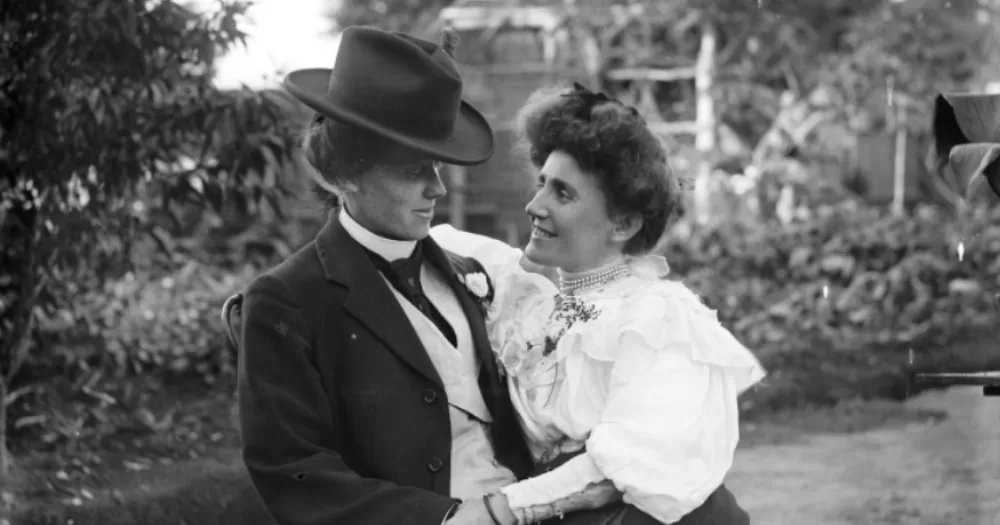
Long before dating apps and instant swipes, connection required patience, courage, and often a leap into the unknown. In the absence of digital platforms, personal ads, also known as classifieds, offered a rare and vital space for people to seek companionship, romance, and friendship. Dating back to the 1700s, personal ads became especially significant for lesbians, who relied on subtlety and coded language to find one another in a society that often denied their existence.
Publications like The Link, a monthly newspaper running from 1915 to 1921, emerged during a time of profound social change. Created by journalist Alfred Walter Barrett, it responded to what he described as a “crisis of loneliness” during the First World War. With many men at war or lost, women experienced new freedoms working, living independently, and forming close bonds with one another. For some, these relationships went beyond friendship, though such connections had to remain largely secretive.
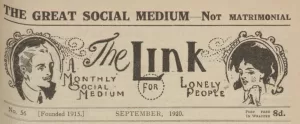
Within The Link, advertisers described themselves and their desires in carefully chosen words. Phrases like “bohemian”, “unconventional”, or references to artistic and literary interests often signalled something more beneath the surface. In just a few lines, such as those from From The Link, March 1, 1917, individuals sketched out what was potentially early lesbian personal ads, describing entire lives and hopes for connection:
“Bachelor Girl (Scotland), 27, happy-go-lucky, sociable, fond of reading, though not a ‘blue-stocking,’ will be glad to make interesting ‘pen-friends’ who care for correspondence.”
“Young Lady (B’ham), 19, refined, would be pleased to meet jolly girl as friend for evenings and week-ends. Residing B’ham preferred.”
By 1921, discussions around criminalising relationships between women had reached the House of Lords in the UK. Though ultimately struck down, the proposed legislation reflected widespread hostility. The press further fuelled fear, portraying lesbians as immoral or deviant, culminating in high-profile controversies like the obscenity trial of The Well of Loneliness later in the decade.
Despite these challenges, the spirit of connection endured. Decades later, queer communities carved out new spaces through zines, DIY publications rooted in punk and feminist movements. Zines became a powerful medium for sharing stories, politics, and personal ads. They weren’t driven by profit but by a desire to build community and visibility. On Our Backs, a lesbian erotica zine launched in 1984, reimagined what feminist publishing could be: playful, sexy, and queer.
View this post on Instagram
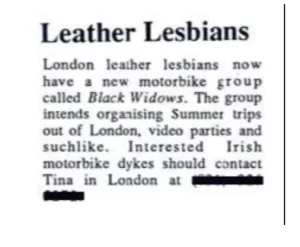
In Ireland, our very own GCN continued this tradition. Its debut issue in 1988 featured bold, unapologetic ads, including: “London leather lesbians now have a new motorbike group called Black Widows. The group intends organising Summer trips out of London, video parties and suchlike. Interested Irish motorbike dykes should contact Tina in London at…”
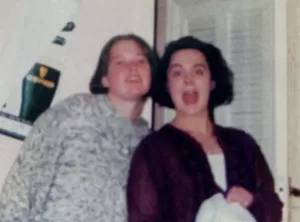
For some, these ads changed everything. In 1994, Dawn, newly out and living in Tramore, placed her own ad: “Young female, 17, Waterford, seeks female 17+ for correspondence and hopefully relationship. Any area. Sincere replies please, photos appreciated,” she wrote.
One of the respondents was Paula. What followed was a slow, deliberate courtship through letters, each envelope bringing anticipation and excitement. “We got to know each other through letters and phone calls. We took the time to learn about each other’s interests before meeting in person.”
Their first meeting came just months later, slightly awkward but filled with promise. More than three decades on, Dawn and Paula are still together, their relationship rooted in the patience and intention of those early exchanges. “I wouldn’t trade the last 31 years for the Irish Presidency!” Dawn laughs.
Their story highlights what has been lost as well as gained in the shift to digital dating. While apps offer accessibility and speed, they often lack the depth created by time and effort. Letters, unlike messages, cannot simply be deleted; they become artefacts, holding memories and emotion.
© 2026 GCN (Gay Community News). All rights reserved.
Support GCN
GCN is a free, vital resource for Ireland’s LGBTQ+ community since 1988.
GCN is a trading name of National LGBT Federation CLG, a registered charity - Charity Number: 20034580.
GCN relies on the generous support of the community and allies to sustain the crucial work that we do. Producing GCN is costly, and, in an industry which has been hugely impacted by rising costs, we need your support to help sustain and grow this vital resource.
Supporting GCN for as little as €1.99 per month will help us continue our work as Ireland’s free, independent LGBTQ+ media.