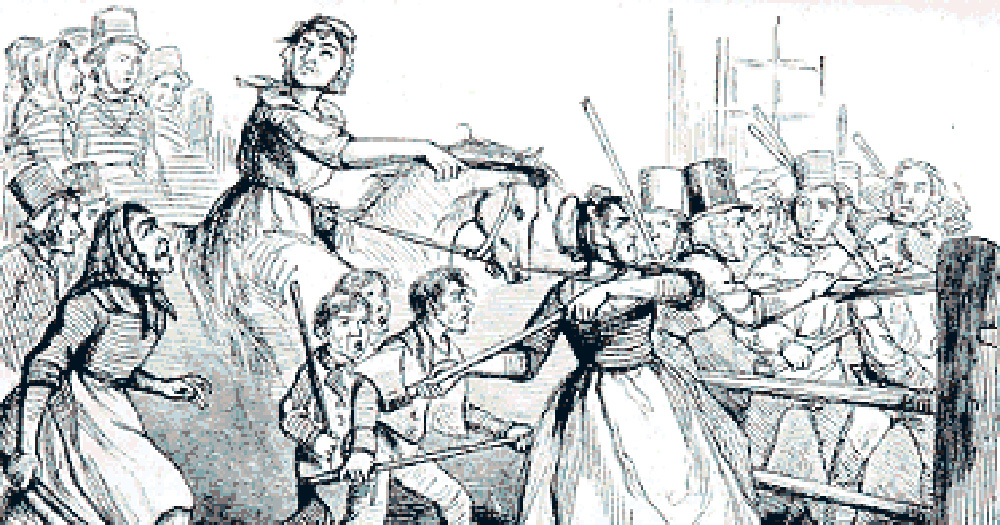
Who said that farmers couldn’t drag? Between 1839 and 1843 in the rural parts of west Wales, tenant farmers disguised as women attacked toll gates in protest against the fees charged to use the roads, in what would become known as the Rebecca Riots.
These tolls were imposed because Welsh roads at the time were in poor condition, and turnpike trusts built tollgates to charge for access to the new roads. They were a heavy burden for small farmers who needed the roads to transport crops and livestock to markets, or to collect lime to fertilise their fields.
But tolls weren’t the only issue. A rising population meant increased competition for land and jobs, adding to unemployment and poverty. Landlords, seeking more profit, began consolidating small plots into larger farms that could only be rented at higher prices.
On top of that, farmers were required to pay tithes – a tenth of their produce – to a church that wasn’t even their own. The 1834 Poor Law forced able-bodied poor people into workhouses where conditions were intentionally harsh, based on the belief that poverty was due to laziness or moral failure.
Poor harvests in 1837 and 1838 worsened the crisis, followed by an economic depression in 1842. Social divisions ran deep: the gentry, English-speaking and Anglican, owned the land, while the Welsh-speaking tenant farmers and labourers, often Nonconformist in religion, worked it. The tolls came to symbolise this inequality, seen as tools of the gentry’s power.
The first protest erupted in May 1839, when a new tollgate at Efailwen was destroyed, rebuilt, then destroyed again. Things quieted down until 1842, when unrest resumed and the magistrates called in the marines. But in 1843, the movement exploded again.
In May, toll gates at Carmarthen were destroyed, and in June, a crowd of 2,000 tried to burn down the workhouse. Landlords received threatening letters, urging them to lower rents. Individuals who defied the movement – who broke what the protesters called “the people’s law” – were violently attacked.
During the riots, men disguised themselves as women and called themselves “Rebecca and her daughters,” referencing a Bible passage (Genesis 24:60) in which Rebecca is told her descendants will “possess the gate of those who hate them.”
Sometimes, faces were blackened, masks worn. The drag was a way to avoid recognition and a reclaiming of religious norms. Oppressed men could rebel through a performance. Dressed in women’s clothes – part of a Welsh tradition of popular justice called Ceffyl Pren – they weren’t breaking the law as individuals, but enacting the will of the community. And they were doing so through drag before it had a name.
Prior to destroying the toll-gates, ‘Rebecca’ would call to his followers who were also dressed as women and perform a scene which involved the following words:
Rebecca: “What is this my children? There is something in my way. I cannot go on….”
Rioters: “What is it, mother Rebecca? Nothing should stand in your way.”
Rebecca: “I do not know my children. I am old and cannot see well.”
Rioters: “Shall we come and move it out of your way mother Rebecca?”
Rebecca: “Wait! It feels like a big gate put across the road to stop your old mother.”
Rioters: “We will break it down, mother. Nothing stands in your way.”
Rebecca: “Perhaps it will open…Oh my dear children, it is locked and bolted. What can be done?”
Rioters: “It must be taken down, mother. You and your children must be able to pass.”
Rebecca: “Off with it then, my children.”
Interestingly, the public critique of the riots focused less on the drag than on the violence. As the movement became more intense, troops were deployed. Eventually, the Rebecca Riots were crushed. Some protesters were arrested and sentenced to transportation. Still, their efforts had an impact, as the government reformed both the toll system and the Poor Law, and economic conditions gradually improved.
Decades later, drag performers – often queer, racialised, and working-class – would take up drag as resistance once again. Like Rebecca and her daughters, today’s drag artists use costume, exaggeration, and theatricality to fight oppression and to mock society. Like the rioters in 19th-century Wales, modern queens and kings step into character to take up space, demand visibility, and challenge systems that would rather erase them. So yes, farmers could drag. And maybe, they were queens all along.
© 2026 GCN (Gay Community News). All rights reserved.
Support GCN
GCN is a free, vital resource for Ireland’s LGBTQ+ community since 1988.
GCN is a trading name of National LGBT Federation CLG, a registered charity - Charity Number: 20034580.
GCN relies on the generous support of the community and allies to sustain the crucial work that we do. Producing GCN is costly, and, in an industry which has been hugely impacted by rising costs, we need your support to help sustain and grow this vital resource.
Supporting GCN for as little as €1.99 per month will help us continue our work as Ireland’s free, independent LGBTQ+ media.