This article is part of GCN’s new Amach le Bród (Out with Pride) series, to combat anti-LGBTQ+ misinformation and platform underrepresented voices. The project was funded by the Coimisiún na Meán News Reporting Scheme.
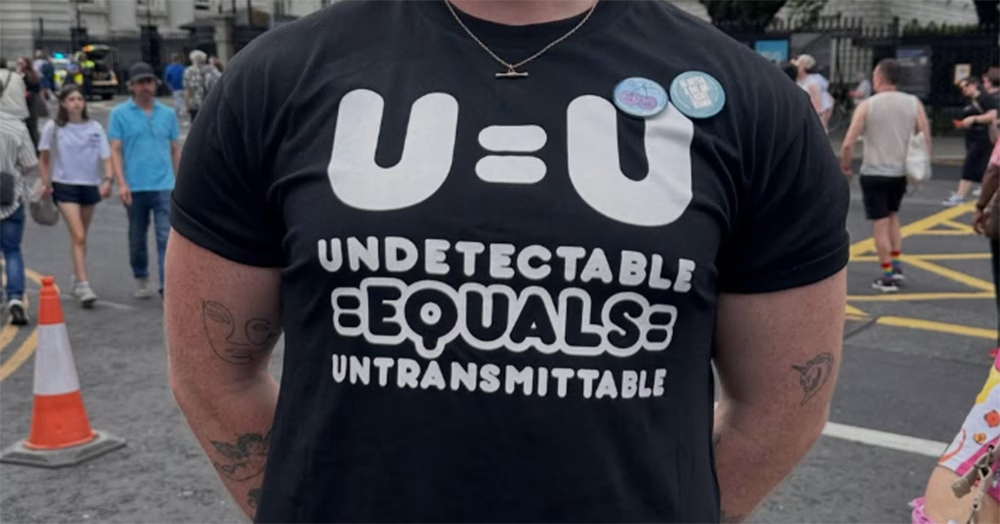
The history of HIV is often told as a story of tragedy and loss. Yet it is also a story of extraordinary scientific progress and the determination of communities who refused to accept stigma or silence. Together, science and community transformed HIV from a fatal diagnosis into a manageable condition and ultimately gave rise to one of the most important public health messages of our time: U=U (Undetectable=Untransmittable).
In 1987, the first HIV treatment, AZT (Azidothymidine), was approved for use. While it offered an initial glimmer of hope, it was only moderately effective at slowing the progression of HIV. Ultimately, the virus developed resistance, limiting its long-term benefit.
The revolution in HIV treatment really began in 1996 with the introduction of HAART (Highly Active Antiretroviral Therapy), later known simply as ART (Antiretroviral Therapy). By combining multiple antiretroviral drugs that targeted the virus at different stages of its life cycle, ART prevented resistance and transformed HIV from a terminal illness into a manageable chronic condition.
Although early treatment regimens required people to take numerous pills each day, often with debilitating side effects, modern HIV treatment has become remarkably simple. For most people, it now consists of a single daily tablet or, increasingly, a long-acting injectable administered every one or two months.
Consistent adherence to treatment suppresses HIV to levels so low that it becomes undetectable in the blood. This keeps the immune system healthy, enables people living with HIV to enjoy a normal life expectancy and offers another extraordinary benefit that, back then, had yet to enter public consciousness.
Researchers had long understood that the amount of HIV in a person’s blood, known as the viral load, was directly linked to the likelihood of sexual transmission. As treatment became capable of reducing viral load to undetectable levels, an obvious but revolutionary question emerged: if there is effectively no virus to pass on, can HIV be transmitted at all?
In 2008, an expert panel of clinicians in Switzerland issued what became known as the ‘Swiss Statement’, advising that a person living with HIV who is on effective treatment with a sustained undetectable viral load cannot sexually transmit the virus. The statement was bold and, at the time, controversial. While many accepted the biological rationale, others called for definitive clinical evidence.
In 2011, the landmark HPTN (HIV Prevention Trials Network) 052 study followed more than 1,700 serodiscordant couples, where one partner was living with HIV and the other was not, across several countries. It demonstrated that effective HIV treatment prevented sexual transmission.
The findings were strengthened further by the PARTNER study in 2014, which documented more than 58,000 instances of condomless sex between heterosexual serodiscordant couples without a single linked HIV transmission. To remove any remaining doubt, the PARTNER2 study confirmed exactly the same result among gay male serodiscordant couples.
By 2014, the science was clear and indisputable: when HIV is undetectable, it cannot be sexually transmitted. Yet, if the science was settled, why wasn’t everyone talking about it?
That was the question Bruce Richman was asking in New York City when his doctor told him he had an undetectable viral load and explained what it meant. Realising that this knowledge had the power to transform the lives of millions of people living with HIV, Richman became frustrated by the silence surrounding it. He began contacting HIV specialists, learning about the science and mobilising experts and activists to join him in founding Prevention Access Campaign in 2015.
View this post on Instagram
The following year, the organisation’s global coalition of researchers, clinicians and advocates released a consensus statement, coining the phrase ‘U=U’ (Undetectable=Untransmittable) and launching what would become one of the most successful public health communications campaigns in recent history. By 2017, leading HIV organisations and public health agencies across the world had signed the consensus statement, embracing U=U as a simple, evidence-based message capable of transforming both public understanding and the lives of people living with HIV.
Ireland was no exception. Organisations including the Gay Health Network and their members, HIV Ireland and ACT UP Dublin became early signatories, recognising the transformative potential of U=U and moving quickly to spread the message through social media, public education campaigns and community outreach. For the first time in decades, the conversation was beginning to shift from fear to facts.
A landmark moment came in 2019 when Bruce Richman was invited to Dublin to deliver the keynote address at the Gay Health Forum. Bringing together healthcare professionals, community organisations and people living with HIV, his visit reinforced Ireland’s growing commitment to making U=U a central part of HIV education. It also highlighted that the messaging was about much more than science. It was about restoring confidence, relationships, intimacy and dignity.
Momentum continued to build. But this momentum did not happen by accident. Community activists continued to press for U=U to be embraced at every level of Ireland’s HIV response.
ACT UP Dublin brought the message to the streets through its characteristically bold and disruptive activism, ensuring that it remained impossible to ignore. Meanwhile, advocates within organisations such as HIV Ireland, alongside colleagues across regional sexual health charities, worked behind the scenes with public and sexual health leaders to embed U=U into policy and clinical practice. Crucially, many of those sexual health leaders did more than simply listen; they became champions of the message in their own right, sharing it in their consultations and helping to ensure that the evidence was translated into national policy and public health action.
All of these combined efforts created the conditions for a watershed moment. In January 2020, the HSE launched its first national U=U campaign, with advertisements appearing on public transport, in community venues and across social media. Possibly for the first time since the fear-based HIV campaigns of the 1980s, Ireland’s national public health messaging about the virus was centred on empowerment.
Yet lasting change cannot be achieved through public health campaigns alone. It depends on communities continuing the conversation long after the campaign ends. In Ireland, few organisations have embodied that role more than Poz Vibe Tribe.
Beginning as the Poz Vibe podcast, created by and for people living with HIV, the group has given voice to experiences that have too often remained hidden. They have created a space where conversations about diagnosis, treatment, relationships, disclosure, mental health and stigma can take place openly, honestly and often with a good laugh.
As the movement grew, so too did their ambition. Evolving into Poz Vibe Tribe, they have become a vibrant community of activists, artists and advocates working to dismantle stigma, empower people living with HIV and ensure that those most affected are leading the conversation about their own lives.
Through collaborations with the HSE, including the national You, Me & HIV campaign, the Poz Vibe Tribe is helping to transform U=U from a scientific message into a human one. They use authentic stories of people living with HIV and those who love them to challenge misconceptions and replace fear with understanding.
In doing so, Poz Vibe Tribe has not only helped increase public awareness of U=U, but they have also created something equally important: a visible, confident community that is reclaiming their narrative and showing that HIV is no barrier to living a full, healthy and connected life.
View this post on Instagram
When communities change the conversation, culture follows. Film, theatre, television and radio increasingly began reflecting the realities of life with HIV in the era of effective treatment, replacing decades of fear-based narratives with stories of resilience, intimacy and hope. Anna Rodgers and Shaun Dunne’s How to Tell a Secret and Pradeep Mahadeshwar’s Out of the Shadows gave voice to the lived experiences of people living with HIV, exploring disclosure, stigma and the freedom that comes with telling your story.
While Ireland has yet to see a dedicated U=U storyline in popular TV shows and soaps, as has happened in the UK, discussions about modern life with HIV have increasingly reached the public through programmes such as The Late Late Show, The Tommy Tiernan Show, RTÉ Radio 1’s The Undetectables and the documentary Memorial: The Story of HIV/AIDS in Ireland. These works have helped reshape the cultural narrative, replacing outdated myths with stories grounded in science and everyday realities.
The U=U movement began with science, but it was communities of people living with HIV who transformed that science into a global movement. Scientific discoveries alone do not change lives. People do. Every conversation, campaign, artwork, podcast and personal story has helped dismantle decades of stigma built on fear and misinformation.
Yet the work is not finished. Too many people still do not know what U=U means. Too many people living with HIV continue to experience discrimination based on myths that modern medicine disproved years ago.
U=U is far more than a slogan. It is one of the most important public health messages of our time. It encourages testing, supports treatment, strengthens relationships, improves mental wellbeing and dismantles stigma with every person who learns the facts.
Whether you are living with HIV or not, you have a role to play in the next chapter of this story. Talk about U=U. Share it with friends, family and colleagues. Challenge misinformation when you hear it. Support the organisations and communities that continue this work every day.
The science has already changed what it means to live with HIV. Now it is up to all of us to ensure that society catches up.
Adam Shanley has worked in gay men’s sexual health for over a decade, most notably founding and leading the MPOWER Programme at HIV Ireland. He is currently a Doctoral Researcher at Trinity College Dublin’s School of Medicine, developing an online pathway of care for the national HIV PrEP programme.
© 2026 GCN (Gay Community News). All rights reserved.
Support GCN
GCN is a free, vital resource for Ireland’s LGBTQ+ community since 1988.
GCN is a trading name of National LGBT Federation CLG, a registered charity - Charity Number: 20034580.
GCN relies on the generous support of the community and allies to sustain the crucial work that we do. Producing GCN is costly, and, in an industry which has been hugely impacted by rising costs, we need your support to help sustain and grow this vital resource.
Supporting GCN for as little as €1.99 per month will help us continue our work as Ireland’s free, independent LGBTQ+ media.