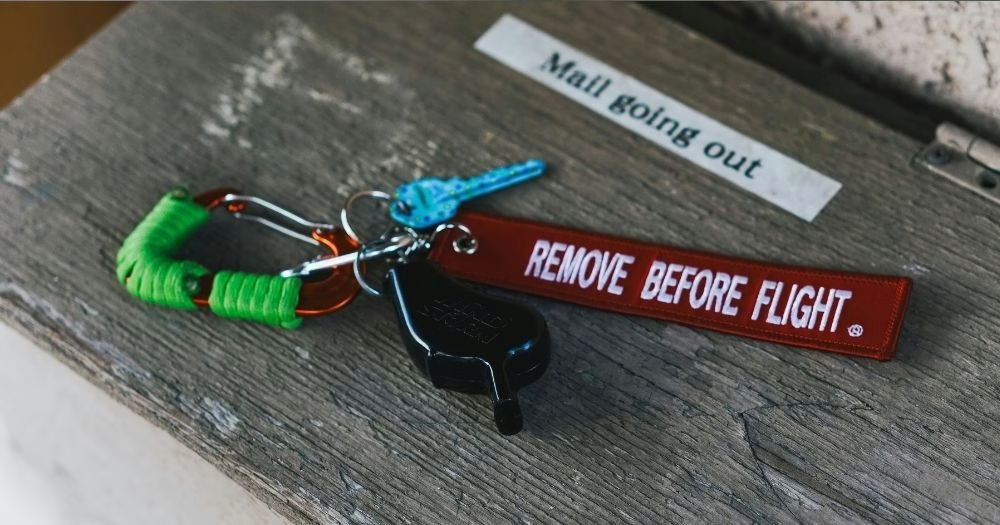
Carabiners have long been recognised informally as a lesbian symbol, but where did this association begin? Aside from being fashionable with a purpose, there are historic links between the queer community and the carabiner accessory. And no, it’s not just for the climbing gays!
Culturally speaking, small accessories and signifiers are frequently used in the queer community to signal LGBTQ+ identity, be it subtle tees or thumb rings, and the carabiner is no exception.
German climber Otto Herzog created the modern carabiner in 1911, and it gained popularity in the following decades as both a climbing and a working-class utility tool.
Tracing back to World War II, more women began to enter the workforce, particularly taking over industrial jobs. Despite previous restrictions and social taboos on women in the workforce, the shortage of labour during wartime led to a necessary shift towards women working, alongside the efforts of the women’s liberation movement. For butch, masc, and gender non-conforming lesbians, this shift towards blue-collar work was necessarily more prominent.
Within these typically male-dominated workplaces, women began, by nature of the job, to wear carabiners as a useful working tool. As the women’s liberation movement began to gain momentum, and more lesbians entered blue-collar jobs, the carabiner became an unofficial symbol and signifier for working-class lesbians, and beyond.
Moving into the 70s feminist movement, the carabiner was adopted more formally as a visual means of rejecting gender norms and traditional feminine aesthetics. With sapphics at the forefront of the feminist movements, these associations became more evident, particularly for masc lesbians.
This is reflected in seminal queer texts such as Leslie Feinberg’s Stone Butch Blues, which explores lesbian lives and queer subculture from the 50s to the 80s, following a butch main character Jess Goldberg, who spends much of the book working across factory and industrial jobs.
Today, the carabiner has become more mainstream in fashion and remains both a useful tool and a fashionable queer accessory. While it has been viewed as a stereotype at times, it evidently remains an essential marker of expression and utility, with historic importance to the LGBTQ+ community.
Furthermore, the carabiner has also historically been used to indicate sexual preference, depending on which side of the waist it is hung from. Particularly during the 70s, it was recognised that placing the carabiner on the left indicated someone preferred to top and right indicated bottom. It thereby echoes the hanky code, historically used by gay men to indicate preferences, placing a bandana in the left or right back pocket.
Alison Bechdel (of the Bechdel test) also brought the carabiner into conversation in her acclaimed graphic memoir, Fun Home, from 2006. In one of the comics pages, Bechdel notices another lesbian by virtue of her carabiner. The musical version of the memoir features this scene with the song ‘Ring of Keys’.
From climbing gyms to Pinterest boards, carabiners have been cemented as a symbol of lesbian identity in contemporary cultural spheres.
© 2026 GCN (Gay Community News). All rights reserved.
Support GCN
GCN is a free, vital resource for Ireland’s LGBTQ+ community since 1988.
GCN is a trading name of National LGBT Federation CLG, a registered charity - Charity Number: 20034580.
GCN relies on the generous support of the community and allies to sustain the crucial work that we do. Producing GCN is costly, and, in an industry which has been hugely impacted by rising costs, we need your support to help sustain and grow this vital resource.
Supporting GCN for as little as €1.99 per month will help us continue our work as Ireland’s free, independent LGBTQ+ media.