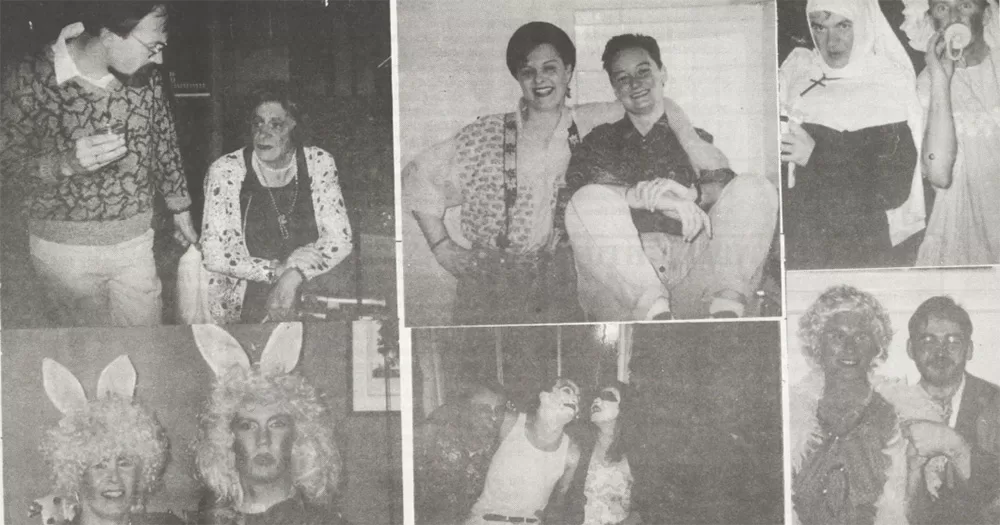
I find myself once again dwelling on Flikkers, the legendary gay Dublin disco, having been perusing an online GCN article about it. I thought I’d take a meander through my memories and how I felt whilst actually being there, inside the safety zone. As a part of the still living history of the club (that only lasted for eight years), my thoughts and introspections may be of interest to those who are concerned with the history of the queer scene in the Irish capital all those years ago.
I’m trying to evoke the thoughts that were going through my mind in those halcyon days of Irish queerdom, rather than the physical euphoria of dancing the night away to Donna Summer et al. Flikkers has at times been referred to as a dance club that was at the cutting edge of Dublin clubland. Undoubtedly, these opinions are true, but I didn’t see it as a dance club and still can’t see it as having been just that.
It was a disco for sure with the latest tunes, but that was almost a sideline issue. Flikkers was the place in Dublin where gay people congregated when the pubs shut and where you could safely let your hair down. It was where you went to find forbidden love that, inside its walls, did indeed dare to speak its name. It was where you went to party and to touch, and be touched by, other men or women, so long as they were the same sex as you were.
The sense of freedom was immense and profound, and when accompanied by the music from the booming Bose speakers, it was sublime. Being there brought to life, in vivid living colour, the subjects of your dreams and established a personal and emotional renaissance far greater than anything that you might have, or could have, imagined.
It was going from the darkness into the light; a departure from the tyranny of societal heteronormativity to the anthropological liberty and freedoms of being with your own tribe. Finally, one amongst equals. And of course, this meant that all of a sudden, everything seemed possible…on your own terms.
It was a sense of complete euphoria to enter the Hirschfeld Centre, and especially Flikkers, for the first time. It was an enormous mental pyrotechnic display, showering your mind with coruscating shards of vivid colour; as if it had been raining your entire life and all of a sudden the clouds disappeared, and the sunshine with its calming warmth came flooding out. It was that good!
On the first floor was a series of bench-type seats, of the type you might find in a diner, where you could sit together and chat (or snog). It was quite dark, and this added a layer, or feeling, of intimacy to the liaison. Something that could not be replicated in similar settings in the straight world, unless of course you were actually straight.
We now had our own sites of intimacy and privacy. We could snuggle up and have those intimate conversations that lovers have, and not be looked upon with disgust and disapproval.
Upstairs at the disco, you could dress as you liked and fling yourself about with (ironically) gay abandon and not worry about being targeted as a “f*ggot” because you could actually dance in time to the music – an innate talent of the state of queerdom.
It all added to the sense of freedom that was now the very lifeblood of your resurrection as a fully fledged queer. You looked around and realised that you had finally arrived home.
The year I write about is 1981. At that time, it was “illegal” to be gay in Ireland. You might just as well say that it was “illegal” to be tall or to have blonde hair. But the fact was that you could end up in a lot of trouble in your place of employment, with the law, with any number of situations or scenarios, so there was always that pressure to conform to societal norms.
Additionally, there was the stigma that was associated with being queer. All this was in your head, on your mind. Going to Flikkers gave some respite from these pressures and allowed the real person, unencumbered by the prejudices of wider society, to breathe freely.
It is so important to have places like Flikkers, particularly in times when people are having the pressures of bigotry placed upon them. Commercial clubs are all well and good, but their raisin d’etre is not the camaraderie that Flikkers or the Hirschfeld Centre provided. The warm sunlight after the clouds and rain.
Indeed, it would be wonderful to have a brand new Flikkers concentrating on trans, non-binary and other gender non-conforming people. I feel that this could mark a new beginning and a complete support centre for so many people. In the late ’70s and early ’80s, indeed even now, there was a concentration on gayness. This still needs attending to; however, there are many other diverse genders and sexualities still sheltering from the rain.
Imagine if we could open up a really inspired place that would welcome them in from the cold in the way that Flikkers did for my generation of gay and queer people in Dublin. Now that really would be progress.
© 2026 GCN (Gay Community News). All rights reserved.
Support GCN
GCN is a free, vital resource for Ireland’s LGBTQ+ community since 1988.
GCN is a trading name of National LGBT Federation CLG, a registered charity - Charity Number: 20034580.
GCN relies on the generous support of the community and allies to sustain the crucial work that we do. Producing GCN is costly, and, in an industry which has been hugely impacted by rising costs, we need your support to help sustain and grow this vital resource.
Supporting GCN for as little as €1.99 per month will help us continue our work as Ireland’s free, independent LGBTQ+ media.